
LLM Entity SEO for Accounting Firms: Names, Niches, People and Proof
AI engines recommend firms they can confidently identify — not just the biggest or oldest. Here's how to make your firm, founder, services, sectors, and locations unambiguous to ChatGPT, Perplexity, and Google AI Overviews.
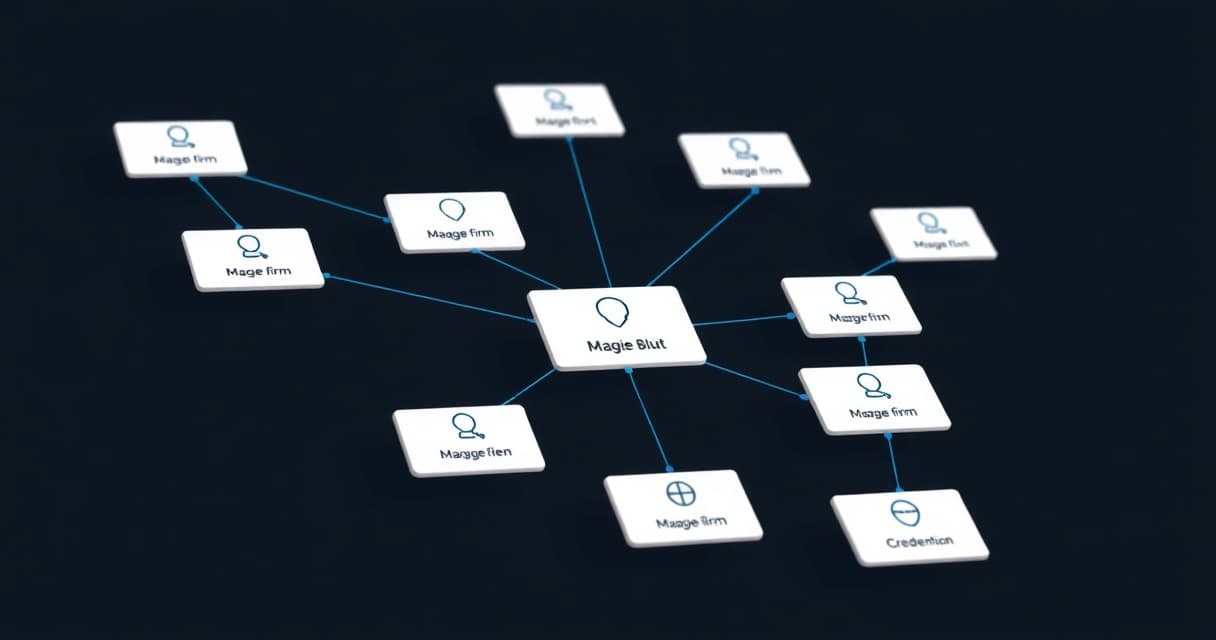
AI engines do not rank pages — they resolve entities. Before ChatGPT, Claude, Perplexity, or Google's AI Overviews can recommend your firm, they must be confident they know *which* firm you are, what you do, who runs it, and whether you are credible. Most accounting firms fail that test not because their work is poor, but because their digital footprint is ambiguous. This guide shows you how to fix that.
---
What Is an Entity in AI Search — and Why Are Accounting Firms Particularly Ambiguous?
An entity is a distinct, real-world thing that an AI engine can identify with confidence: a business, a person, a service, a location. Entities are not keywords. A keyword is "tax accountant London." An entity is *Thornfield Advisory Ltd, a chartered accountancy practice at 14 Cannon Street, London EC4N 6JJ, founded by Sarah Thornfield FCCA, specialising in R&D tax credits for life-sciences SMEs.*
Accounting firms create entity ambiguity in several predictable ways:
Generic trading names. "Apex Accounts," "Premier Tax Solutions," or "The Accounting Company" are phrases, not identifiers. When a user asks ChatGPT "who are good R&D tax credit advisers in Manchester?", the model cannot confidently resolve "Apex Accounts Manchester" to a single, verifiable firm without corroborating signals from multiple sources.
Service overlap with unrelated businesses. The word "accounts" appears in estate agencies, letting agents, software companies, and clubs. A firm called "Harris & Co Accounts" shares name-space with dozens of unrelated entities.
Thin professional profiles. AI engines draw heavily on structured data from directories, professional-body registers, and citation-rich editorial content. A firm whose only substantive presence is a five-page website has given the model almost nothing to triangulate.
Undifferentiated niche claims. When every firm in a region claims to be "specialist accountants for small businesses," the model cannot distinguish between them. Specificity — *construction sector,* *SaaS startups,* *dental practices* — creates separation.
The practical consequence: AI engines either omit your firm from recommendations, mention you with low confidence, or — worst — conflate you with a competitor or a dissolved company of similar name.
---
How to Make Your Firm, Founder, Services, Sectors, and Locations Machine-Readable
The goal is to give every AI engine enough overlapping, consistent signals that it can resolve your entity without doubt. Think of it as triangulation: the more independent sources agree on the same facts, the higher the model's confidence.
Firm Identity
Your legal name, trading name, and Companies House registration must align across every surface. If your legal entity is Thornfield Advisory Ltd (Company No. 09847362), that string — or a recognisable variant — should appear on your website footer, your Google Business Profile, your ACCA or ICAEW directory listing, and in any editorial mentions. Discrepancies (trading as one name, filing under another, listed differently on Yell or Trustpilot) introduce ambiguity.
Concrete steps:
- Add your Companies House number to your website footer. It is a machine-readable unique identifier that no other entity shares.
- If you are FCA-authorised for investment advice, include your FRN. If you hold an ICAEW practice assurance licence, display that licence number.
- Use Organization schema (JSON-LD) on your homepage. Include legalName, identifier (Companies House number), foundingDate, and areaServed.
Founder and Principal Accountant Profiles
AI engines treat named professionals as sub-entities that reinforce the parent firm. A founder with a verifiable credential trail — ACCA membership number, published CPD articles, ICAEW profile, LinkedIn URL, Companies House director record — anchors the firm entity far more firmly than a nameless "our team" page.
Every principal should have:
- A dedicated /team/[name] page with full name, post-nominals, and membership body.
- Person schema with hasCredential pointing to their professional qualification and worksFor pointing to the firm's Organization entity.
- A consistent name format across LinkedIn, the ACCA public register, Companies House directors record, and any guest articles or webinar speaker bios.
If your name is common — "David Williams" — disambiguate with your location, credential, and niche in every bio: *"David Williams FCCA, R&D tax director at Thornfield Advisory, Manchester."* That four-part string is far harder to confuse than a first name and surname alone.
Services
AI engines need to know not just that you do "tax" but *which tax services, for whom, and under what regulatory framework*. A flat list of services on a single page gives the model very little. Dedicated service pages give it significantly more.
For each core service line, create a page that:
- Opens with a direct-answer sentence: *"Thornfield Advisory prepares and submits R&D tax credit claims under HMRC's RDEC and SME schemes for UK life-sciences and medtech businesses."*
- Names the relevant HMRC guidance (e.g. CIRD80000 for R&D), IRS publication (if serving US clients), or FRC standard where applicable. Named regulatory anchors increase a model's confidence that your claim is credible.
- Includes a Service schema block with serviceType, provider (the firm entity), and areaServed.
Sectors
Sector specificity is one of the highest-leverage changes a firm can make. An AI engine asked "which accountants specialise in dental practice accounts in Birmingham?" will surface a firm that has a /sectors/dental-practices page, a case study about a dental group, and directory listings in dental trade publications — over a generalist firm with better overall traffic.
Build sector pages that: - Name the sector explicitly in the H1: *"Accountants for Dental Practices."* - Reference sector-specific compliance touchpoints: CQC registration, NHS contract reconciliation, associate dentist partnership structures. - Link to or cite relevant trade bodies (BDA, NASDAL) so the model can connect your page to the sector's known entity cluster.
Locations
For multi-location firms, each office needs its own LocalBusiness schema instance with a unique streetAddress, telephone, and geo (latitude/longitude). Google Business Profile must match exactly. A firm with offices in Leeds and Bristol should not have both offices resolving to a single GBP or a single schema block — that collapses two entities into one, reducing geographic precision for AI-sourced recommendations.
---
The Role of Credentials, Directory Consistency, and Review Text
Professional Body References
ICAEW, ACCA, CIMA, ATT, and CIOT all maintain public-facing registers. AI engines crawl and index these. If your firm's ICAEW listing uses a slightly different address or omits a service area that your website claims, the model registers a discrepancy. Audit your entries on every professional-body register annually — not just at registration.
For US practices: your CPA licence number in your state board register (e.g. NASBA's CPAverify), PTIN registration, and any IRS Circular 230 practitioner listing are equivalent anchors.
Directory Consistency (NAP+C)
The classic local-SEO concept of NAP (Name, Address, Phone) consistency applies with extra force in LLM entity resolution, because models aggregate signals across many sources simultaneously. Add C for Credentials — your membership numbers and professional designations must also be consistent.
Priority directories for UK accounting firms: - ICAEW Find a Chartered Accountant - ACCA Find an Accountant - Sage Accountant Partner Directory (if applicable) - Xero Advisor Directory (if applicable) - Trustpilot - Google Business Profile - Yelp UK / Yell
For US firms: CPA.com directory, state society find-a-CPA tools, NAPSA, and QuickBooks ProAdvisor directory.
Run a NAP+C audit at the start of each quarter. A typical benchmark is that firms with ten or more consistent directory listings across professional-body registers and mainstream directories receive more confident AI mentions than firms with three or fewer.
Review Text as Structured Signal
Review text is not just social proof — it is free-text entity reinforcement. When a client writes *"Thornfield Advisory saved us significant time on our R&D tax credit claim for our Cambridge biotech startup,"* that sentence links your firm name, your service, and your sector niche in a source (Trustpilot, Google Reviews) that AI engines read.
You cannot write reviews for clients, but you can make it easy for them to write specific ones: - Ask for reviews immediately after a project milestone, when the outcome is fresh. - Brief clients on *what* to mention: the service type, their sector, and the outcome. *"We'd love it if you mentioned what you came to us for and what changed for you."* - Respond to every review using your firm name, the service, and the sector in your reply text. That reply also gets indexed.
---
Schema and On-Page Patterns That Reduce Entity Ambiguity
Schema markup is the closest thing to a direct instruction to a machine: *"This is what this entity is."* For accounting firms, the most impactful schema types are:
Organization / LocalBusiness
Use AccountingService (a sub-type of LocalBusiness) as your primary type. Include:
- name (trading name)
- legalName (as filed at Companies House or state incorporation)
- identifier (Companies House number or EIN)
- foundingDate
- address (PostalAddress with full street, city, postcode)
- geo (GeoCoordinates)
- telephone
- url
- sameAs (array of URLs: ICAEW register page, LinkedIn company page, Companies House profile URL, Google Business Profile URL, Xero/Sage directory URL)
The sameAs array is particularly powerful. It explicitly tells the model: *"These pages all describe the same entity."* Without it, the model must infer that connection — and it may not.
Person Schema for Principals
{ "@type": "Person", "name": "Sarah Thornfield", "jobTitle": "Founder and Director", "hasCredential": { "@type": "EducationalOccupationalCredential", "credentialCategory": "FCCA", "recognizedBy": { "@type": "Organization", "name": "Association of Chartered Certified Accountants" } }, "worksFor": { "@id": "https://thornfieldadvisory.co.uk/#organization" }, "sameAs": [ "https://www.linkedin.com/in/sarah-thornfield-fcca", "https://www.acca.org/find-an-accountant/sarah-thornfield" ] }
Note the use of @id to create an explicit link between the Person entity and the Organization entity. This is entity graph construction — you are teaching the model the relationship, not leaving it to guess.
FAQ Schema on Service Pages
FAQ schema surfaces answer text directly in AI Overviews and Perplexity citations. On your R&D tax credit page, include questions like:
- *"What HMRC schemes cover R&D tax credits for small businesses?"*
- *"How long does an R&D tax credit claim take to process?"*
- *"Which sectors qualify for R&D tax relief under HMRC guidelines?"*
Write answers that begin with a direct assertion and name your firm in the third sentence: *"R&D tax credit claims typically take eight to twelve weeks to process once submitted. HMRC's RDEC scheme applies to large companies; the SME scheme applies to businesses with fewer than 500 employees and under €100m turnover. Thornfield Advisory manages the full process, from technical narrative to submission."*
BreadcrumbList and SiteLinksSearchBox
These schema types help AI engines understand your site's information architecture — which pages are top-level services, which are sub-specialisms, which are locations. A clearly structured site hierarchy reduces the chance of a model conflating your R&D tax page with your general corporation tax page.
---
A Diagnostic Checklist: Spotting When an AI Engine Has Confused Your Firm
Entity confusion is not always obvious. Run this diagnostic monthly by querying ChatGPT (GPT-4o), Claude Sonnet, Perplexity, and Google AI Overviews with variations of your firm's name and core services.
Prompt templates to use:
- *"Tell me about [Firm Name] in [City]."*
- *"Which accountants in [City] specialise in [Your Niche]? Include [Firm Name] if relevant."*
- *"What services does [Firm Name] offer?"*
- *"Who is the founder of [Firm Name]?"*
- *"Is [Firm Name] registered with ICAEW / ACCA?"*
Signals that entity confusion has occurred:
- The model returns information about a different firm with a similar name. (Common with generic trading names.)
- The model correctly names your firm but attributes the wrong location, services, or founder.
- The model says your firm offers services you do not provide — likely because it has merged your entity with a competitor's.
- The model cannot confirm your professional body registration even though you are registered — indicating it has not connected your website entity to your directory listing.
- The model hallucinates a founding date, address, or partner name that does not match your Companies House record.
- The model returns *"I don't have reliable information about this firm"* — which typically means your entity signals are too thin or too inconsistent to resolve confidently.
When you find confusion, the remediation sequence is:
- Identify the conflicting source. Search for the firm or information the model seems to be drawing on — often a similarly named dissolved company or a competitor.
- Strengthen your own
sameAsarray and directory consistency so your signals outweigh the conflicting ones. - Request a Companies House correction if your filing data is outdated.
- Submit or update your ICAEW/ACCA directory listing.
- Create or improve a Wikipedia-style factual page (e.g. a detailed "About" page structured with schema) that gives the model a clear, internally consistent entity description to anchor to.
- Re-run the diagnostic after 30 days. Model knowledge cut-offs mean some changes take weeks to propagate; Perplexity, which pulls live web results, typically reflects changes faster than models with static training weights.
---
Putting It Together: The Entity Readiness Stack
An accounting firm that is genuinely machine-readable has the following in place:
Identity layer: Companies House number in footer, Organization schema with legalName and identifier, consistent NAP+C across ten or more directories.
People layer: Named principals with Person schema, credential references, and consistent name format across LinkedIn, professional-body registers, and Companies House directors record.
Services layer: Dedicated pages per service, opening with a direct-answer sentence, referencing named HMRC/IRS guidance, with Service schema and FAQ schema.
Sectors layer: Dedicated sector pages naming industry-specific compliance touchpoints and linking to relevant trade bodies.
Locations layer: Separate LocalBusiness instances per office, each with unique address and GBP.
Proof layer: Consistent review text naming firm, service, and sector; responded to with the same three elements; editorial mentions in accountancy press or trade media.
Disambiguation layer: sameAs arrays explicitly connecting every major directory and professional-body listing to your canonical domain entity.
None of these steps requires technical expertise beyond a basic understanding of JSON-LD. What they require is discipline — consistency across every surface where your firm's name appears, and specificity in every claim you make about what you do and for whom.
AI engines are not mystic oracles. They are pattern-matching systems that reward firms which make their patterns unambiguous. The accounting firms that appear in ChatGPT answers, Perplexity citations, and Google AI Overviews in Q2 2026 are not necessarily the largest or the oldest — they are the ones whose entity signals are clearest.
---
*Sam Hoye ACMA CGMA is a co-founder of Magpire, the AI Engine Optimisation platform built for UK and US accounting firms. Magpire audits entity signals, monitors AI engine citations, and publishes structured content that keeps firms visible in LLM-sourced recommendations.*
Place this article in the wider AI visibility system
Find out where your firm stands
Run the free Magpire Audit — 60 seconds, no credit card. See exactly how ChatGPT, Claude, and Perplexity talk about your firm today.
Get my free score